Saturday, 15 October 2011

Why Doing NaNoWriMo is Like a Trip to the Moon


NaNoWriMo 2011 #2

Preparation Tips

Why Doing NaNoWriMo is Like a Trip to the Moon.

By

Mark Lee Pearson

Look at the moon. 2000 miles across, 4.5 billion years old, and it’s mere existence affecting the tides of the earth. Isn’t it amazing?

Your first task is to tell everyone that is where you are going to be during the month of November. That way you will not be invited to any social activities that will eat up your writing time. Also you’ll acquire a bunch of friends willing to cheer a crazy astronaut on. Your significant other will also need to know why you’ll appear to be defying gravity for the entire month of November.

Your second task is to go to bed. Get off the Internet and crawl under your duvet. Yes, now! Or as soon as you’ve finished reading this. You don’t go on a 250,000-mile word journey without preparation. You will need to conserve energy for that moonwalk.

Good night’s sleep? Okay, your next step is to plot the moon’s orbit. One sidereal month is 27.3 days. Create a 27.3-day plan. This will consist of an outline of 27.3 chapters of 1800 words each. Each chapter plan will be a sentence or two stating where you lift-off and where you plan to land—in other words a pay off. That is just like a 27.3 sentence summary of your story. The plan is to complete a 27.3-chapter orbit novel; one chapter a day for 27.3 days, with 2.7 days left open for a couple of blue moon events.

Done that? Right, now it’s time to decide who’s going to be the one to set foot on the moon? Is it Neil or is it Buzz that’ll be your protagonist? Focus on one character’s point-of-view. The more points-of-view you have the more complicated your story gets, so keep it simple so you can take the easiest possible route from start to finish. So, it’s Buzz? Right then, Niel can be your antagonist. You’ll need another character too. Someone who will help your protagonist. How about Sting?

Right, we have a crew. It is almost time to prepare for blast off. The date is set. On 1st November you’ll get up one hour earlier than usual and take 15 minutes to write an outline of the chapter you plan to write.

Yes, that’s right, an outline. If you’ve got a map of the stars you’ll easily be able to find the constellation you are looking for.

The outline will be based on your 1-sentence summary for that day. You will need a starting point and an ending point. You will need to know the characters that will feature in that chapter and all of their motivations. Yes, ALL! Characters without motivations should be jettisoned. You also need to know what you want each one of them to achieve by the end of that chapter. In effect you need to ask yourself, “What is today’s pay off?”

You are ready to blast off! With that pay-off in mind start writing at full acceleration. Fully prepared you should get about 600 words done in 45 minutes. At the 600 word mark leave your characters half way through a sentence and…

…go to work/school/drop the kids off at kindergarten. While doing that, think about your day’s plan and formulate a dialogue incorporating lots of conflict. Ideally the dialogue will encapsulate what you are trying to achieve with today’s chapter. Like a kind of microcosm of the whole. Jot it down if you have a chance. Here’s one I prepared earlier,

“One small step for a man—” said Neil, opening the hatch.

“No,” said Sting, “Wait! Giant steps are what you take walking on the moon.”

Just then, Buzz appeared with an ice pick. “You are both wrong,” he said. “That giant leap will be mine, all mine!”

Arrive at work 30 minutes early and, referring to your dialogue and your day’s plan write 300 words with before anyone else arrives. Then write 300 words on your lunch break. Stay behind and write 300 more words before you go home. You have completed 1500 words.

At home switch off the Internet, TV, PlayStation II…and figure out what you are going to do with all this time in space. Don’t forget to look around you at the stars and enjoy the view of earth. You will most certainly find something to inspire another 300 words...or more.

It takes about two days to get from the Earth to the moon. But once you get there the gravity is one sixth of what it is here on earth, you’ll take giant steps, you’ll feel lighter, and more powerful, almost superhuman. And the view from up there is stunning. NaNoWriMo: enjoy the trip, but keep the momentum.

Tuesday, 11 October 2011

NaNoWriMo: My Experience

Novel Writing and Nanowrimo
by
Mark Lee Pearson

November is Nanowrimo. National Novel Writing Month. Write a 50,000 word novel in 30 days along with a quarter of a million other people on the planet (Yes, I know it should be International Novel Writing Month). I thought I would share with you my Nanowrimo novel writing experience to date.

Once Upon a Time

I’d had a little novel-writing experience before my first attempt at Nanowrimo. I finished one 50,000 word short novel about a Monster Lighthouse Keeper back in 1993 and I also wrote a 60,000 word middle-grade fantasy tale in 2005 about a boy who shrunk to the size of an anchovy and got washed down the plug hole of his bath into a magical sewer.

I doubt either of these will ever see the light of day. I put both stories down to be a part of the learning process, 110,000 words of the necessary 1 million words that you have to write before you are good enough to sell anything.

50,000 words in a month

Anyway in 2008 and I was ready to try again. I’d joined Zoetrope Virtual Studio and started workshopping my short stories. That had given me the confidence to move forward and submit to publishers and as a result I’d had a couple of shorts published in semi-pro magazines. I’d read a couple of How-To-Write-A-Novel books and I was really inspired to make a start on something. 


It was October. I remember Googling the key words How to write a novel and discovering nanowrimo was about to start. Talk about serendipity, I thought. Even though I had two little kids that demanded a lot of my time, I had a very supportive wife; and so on November 1st 2008 I began the novel that would change it all.

No Plot No (Big) Problem

I’d just sold a story to Space and Time Magazine called Hideki Desu. It was about a boy who traveled the Universe by hitching rides on people’s dreams. I wanted to see what I could do with this strange character in a parallel Tokyo over the space of a whole novel. I had a character, a setting and a concept. That was it. No plot no problem, said Chris Baty, the founder of Nanowrimo. 


So, I started writing my novel on the 1st November 2008. Inspired by the pep talks I received by e-mail, I wrote 30,000 words. And then I hit a wall. I was left standing by all those online novelists. And I left Hideki standing on the Tokyo Bay getting ready to jump in. He is still standing there today. I have no idea why. The whole idea of No Plot No Problem was not working for me. I may return to Hideki when I figure out what his motivation is.

Redux: Forward Planning

I stopped writing novels and went back to short stories. From short stories I found I could get a more instant gratification from my writing. I could write a story, polish it and have it sent out to a publisher for consideration in one or two weeks. What’s more I was beginning to have a few more sales and some interest from respectable magazines in the field. However, I was still intent on writing that novel. You know, the one that’s going to make you a Bestselling Novelist? 


I’d had a short story out in the slush piles for about a year about a boy who attracts whales with his voice. It was getting a lot of interest, but no bites. I thought it was the best thing I had written to date and I wanted to explore the characters more thoroughly, so I wrote out a short plan of how I wanted the story to develop. So, when November came around again I threw myself straight back in. This time I had a setting, a bunch of characters, an idea, and an idea for a plot. I couldn’t fail.

Nanowrimo Winner?


The story started well, I had a hook, the characters’ motivations were acting against one another. I had a plot roadmap, which amounted to fifty chapters with one sentence hook for each chapter. I started writing on the first day of November, but soon found that it was really difficult to keep writing 1600 words a day. I was teaching at elementary school and finding I was coming home burned out from lessons and dodgeball. I would catch up at the weekends, but by the third week I was far behind. 


On the last day I remembered what Mur Lafferty had said in her I Should Be Writing podcast; that it was okay to suck. So I wrote 8,000 words of 100% pure unintelligible suck to get me to the finish line. I put the novel aside. I had mixed feelings. Yes, I had completed a 50,000 word novel in the allotted time. Yes, I was now officially recognized as a Nanowrimo winner. But at what cost?


2010: Third Time Lucky

I shut down my computer and wrote nothing for the first nine months of 2010. I wasn’t a writer anymore. I was a failure. Then in September of that year I had an email from a guy called Roque Ruiz at Cloudberry Records who wanted to interview me about my experience of establishing an independent record label in the 1980s. I answered his questions the best I could and found that there was a story there. Roque told me that there was still interest in Ambition Records. I thought it might be an idea to write the story of Ambition. So in November 2010, thanks to Roque’s encouragement, I embarked on my third attempt at Nanowrimo.

This time I was determined to make a go of it. I knew the story and the characters. It was my story. My autobiography. I couldn’t fail. One thing I had learned from my failures was that doing it alone, even though there are many nanowrimers doing it too, was hard. I decided to go public. I opened my office on Zoetrope and posted inspirational articles and pictures for myself as well as the other members of the office. I updated my word-count on my blog, on Facebook, and on Twitter. I challenged other writers to reach the goal before I did. I built a little community around myself. I told everyone, so I had to finish.

The social experience was amazing. I got encouragement from all different areas of my life. And I flew past the goal of 50,000 words on day 26 of nanowrimo. I went on to complete the story at 60,000 words.


I was happy with the outcome, 60,000 words closer to the required million! But I was burned out. I left the story on my hard drive, stopped writing again, and went to play with my kids.

2011

In April 2011 I discovered the Machine of Death Anthology was putting out another call fro submissions for another anthology. I started writing again. I wanted to get in that anthology. I tried and failed the first time. I saw the amount of interest it kicked up on the Twitter and I wanted to be a part of a fantastic book. The characters in the story were the same characters I had worked on with my nanowrimo 2009 novel. 


MOD2 rebooted my interest in writing. I wrote another novella, The Tide Jewels, which will be published later this year at Wicked East Press, and two more short stories, which are now patiently waiting for the attention of a couple of discerning professional magazine editors.

But those characters were still drawing my attention. I knew I had to go back to them. So In August I went back to the novel. I reshaped and replotted it. I cut out 10,000 words of crap, leaving me with a meager 40,000 words. Then in 2 months I rewrote the entire story from scratch ending up with 65,000 words.

It is October and I have now just finished my second editing pass on my Nanowrimo 2009 novel: Whaling the Multiverse. I am burning to send it out, but I still need to give it another few editing passes to iron out some of the flaws I can still see. I am about to put it away for another month while I try Nanowrimo for the fourth time. When that is finished I will not give up writing. I will be ready with my red pen!

November 2011

November is approaching. This time I want to write a story that my kids will read and say, "Hey Dad, I love science fiction!" So I am going to write a middle grade time travel tale. I’ll be ready at the start line with my plan to strike another 50,000 words more off that required one million. See you on the first of November.

Sunday, 9 October 2011

What Can Evel Knievel Teach Us About Writing?


On Being a Daredevil
by
Mark Lee Pearson


“Where there is little risk, there is little reward.”


When I was a kid in the 1970s, I wanted to be like the greatest bike rider of all time, Evel Knievel.


From the time I was eight years old until I was about twelve I spent all my free time practicing jumps over my little brother as he lay in the road, standing on the saddle as I freewheeled down busy high streets, bunny hopping up and down kerbs, and trying out every trick in the book.

Now, luckily for me my parents could only afford to buy me a Raleigh Chopper. The injuries I sustained were minimal. If eight-year old me had been in charge of a Harley Davidson like the great daredevil himself, it wouldn't have been just broken bones and mashed up organs, I would definitely have ended up on a slab. (Along with my fearless little brother...)


The point I am trying to make here is that I threw every little piece of my energy into becoming Evel Knievel. The great daredevil himself said,"Where there is little risk, there is little reward." When I was on my bike, I believed with all my heart that I was him. And little by little I saw my skill as a cyclist improve with each trick I mastered. By the time I was twelve I was invincible on a Raleigh Chopper!


“You come to a point in your life when you really don't care what people think about you, you just care what you think about yourself.


Evel Knievel


Of course, I gave up on my pre-pubescent daredevil dream of being Evel Knievel years ago. Though emulating the great was an important stage in my growth, I know now that it is important to explore my own individual strengths in order to achieve a measure of greatness.

I am a writer now and I am grateful for the lesson that Evel Knievel taught me when I was eight.

I never gave up on that daredevil spirit. I kept taking risks with everything I put my hand to. I became a disc jockey, I formed a record company, I gave up a job in engineering to study philosophy, I studied abroad, I moved to Japan...


I became a writer.


Just as I got back on my Raleigh Chopper every time I fell off--whatever injury I sustained--I now keep submitting my fiction to publishers and magazines, because I believe with all my heart that I have what it takes to be a great writer.

Of course, the rejections pile up. But, you know what? It doesn't matter. It doesn't matter because I can sleep at night knowing that I am doing my best to achieve a measure of greatness.

What am I doing?

1) Writing every day.
2) Finishing what I write.
3) Submitting what I write.

I listen to the advice of others and try to improve my craft. I listen to feedback and try to incorporate it into my stories without compromising my ideas. I take a rejection as a sign of success. At least I can say I was daring enough to try.

I hope you are daring enough to try too.


Tuesday, 4 October 2011

On Discovery vs Outlining


A Tribute to The Dead Robots' Society
http://deadrobotssociety.com/


Road Map to Memphis Hell
by
Mark Lee Pearson


There was once a scientist called Kaiser, who built two robots. She fitted them both with the exact same model of positronic brain. She called one J-Max and the other T-Mix. The two robots were exactly like humans in every respect. They could eat and drink, they could think and feel, and they even had the capability to die.


As an experiment Doctor Kaiser cultured two positronic viruses to infect the positronic brains. She called the viruses The O virus and the P virus--after the two philosophers Bertrand Outliner and Ludwig Pantser--respectively. She then infected one brain with the O Virus and one with the P Virus.


The scientist then set both robots the same task. To plan a vacation for himself. Robot J-Max planned to drive to Memphis. Robot T-Mix decided on a dice-throw to take a plane to the North. He wasn't sure where, he would just figure out the route as he went along.


Robot J-Max purchased a map and a navi for his automobile. He typed his route into routefinder.com and chose the easiest way to get there. Then he searched the internet for a decent steak house and a comfortable motel. He even sought out the cheapest gas stations en route. While surfing the Internet he found by chance there was an all night showing of Lord of the Rings in the local theatre. J-Max rubbed his metallic hands together in glee and booked tickets.


When T-Mix saw J-Max writing out his plan in the greatest detail he scoffed at him, saying, "I'm just gonna get on the plane and see where it takes me. It's more exciting that way."


Doctor Kaiser waved goodbye to them on Saturday morning and they both set off.


J-Max drove carefully and at a steady speed all the way to Memphis. He arrived after lunch and spent the entire afternoon sightseeing and enjoying the ambience of The King's house. Then he treated himself to a steak house meal and rounded off the evening at the drive-in movie theatre watching the Lord of the Rings Trilogy back to back. It was a perfect holiday, thought Robot J-Max.


Robot T-Mix was kidnapped by a character in a green hat on the way to the airport. She said her name was Eliyanna and that she was on the trail of a Ripper Robot, but she was really a bounty hunting drummer called Ryan in disguise. This was gonna be some holiday, thought T-Mix as they drove south with him tied up and gagged in the trunk of her BMW.


Robot J-Max returned on time. He now makes a living writing interminable travelogues and selling them online to pre-paying customers.


Doctor Kaiser has recently traced Robot T-Mix to a brothel on a minor planet in the  70 Virginis System in the year 1969. The bounty hunter sold him as sex slave to a Time Traveling minx from Erotica V, and he still lives out there taking each day as it comes.


Doctor Kaiser and Robot J-Max are planning a way to free him from the clutches of the evil tentacle queen.


UPDATE:


The last we heard Doctor Kaiser was working on a way to combine the two viruses.

Monday, 3 October 2011

On Inspiration


On Inspiration
By
Mark Lee Pearson

On New Years' Day, Hideki dreamed he was standing at the summit of Mount Fuji looking out across the Japanese landscape. He woke up and called his friend, Kimiko.

"I've just been inspired," he said. "Let's climb Mount Fuji this summer."
"Sure," said Kimiko.


Kimiko set about preparing for the climb. She bought a new pair of boots and wore them in. She trained every day. She even joined a hiking club and climbed the low mountains in her district to get herself ready for the big climb.


While Kimiko perspired, Hideki spent the time trying to recapture the moment he had dreamed. He surfed the internet looking for images of Mount Fuji. He drew sketches in his pad. He bought a book about the 100 most famous views. He rode past it on the shinkansen to take in its beauty. He even wrote a haiku.


View from Mount Fuji
Sprawling colors vivid shades
Summer vibrancy


When the day finally arrived Kimiko turned up prepared for the climb. In her pack she had warm clothes, food, and plenty to drink.


Hideki brought his camera, a sketch pad, and a little Japanese flag he intended to have his picture taken with at the summit.


"Race you to the top," he said.


Of course she beat him. Hideki didn't get past the sixth station before he collapsed, out of breath and physically exhausted.


At the summit of Mount Fuji, Kimiko observed the view. She thought it was quite nice. There she met a backpacker from Australia called Alan. He was very nice. He invited her to Nepal with him the following summer. Of course, she went.


She sent Hideki a postcard from the base camp at Mount Everest. On it she wrote a haiku. It said, 


Mountains we may climb,
But dreamy wings fly us not,
To the snowy peaks.


Saturday, 1 October 2011

On Rejection


On Rejection

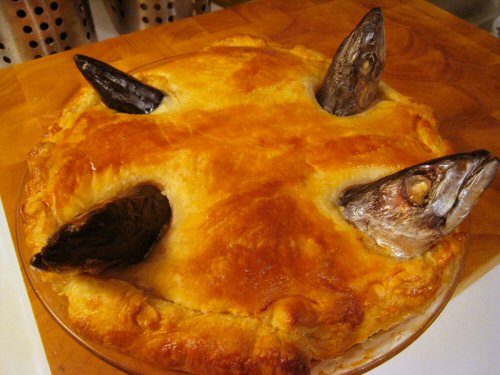
(Or What’s the Best Recipe for Fish Pie?)

By

Mark Lee Pearson


Imagine that you once ate a fish pie that tasted really bad. It was so bad that you told your friends, “I can make better fish pie than that.”

One friend says that he wants to make a fish pie someday, but really doesn’t have the time now.

Another friend says that she once tried to make a fish pie, but she didn’t quite manage to finish it. She decided to leave it in the cupboard because it wasn’t quite right.

You want to ask if her fish pie is still there, but you know by the crazed look in her eyes that it is, so you don’t.

You go home and look in the fridge. There’s a bit of cod and a jar of white sauce. You experiment with these ingredients, but when it comes out of the oven it doesn’t look as appetizing as you thought it would, so you trash it. The next day you make another and trash that one too. You repeat this process over and over again, until you get sick of trying. The refuse collector appears to be gaining weight.

You decide to go ahead and try to sell your fish pies. You do your research and discover that salmon in parsley sauce is popular. So you make a batch and set up a stall at the local market, but it appears that salmon is out and haddock is in. The girl on the stall opposite is making a fortune with her haddock in béchamel sauce.

You steal her recipe and go home to experiment. You emulate her fish pie and try it out on your grandmother. She says it’s the best fish pie she has ever tasted. You decide to set up another stall at the market, but the girl you stole the recipe off is there and hers look so much better than yours. She is making a fortune and the customers just turn their noses up at yours.

You go home and cry and tear up the stupid recipe and throw all your cooking utensils away. That night you have a dream. In the dream a time traveler comes to tell you that he has eaten your fish pie in the future and it was the best he ever tasted. He tells you that you must not give up making fish pie. The time traveler is hot and you wake up realizing that if you give up baking fish pies you will never meet your time traveling dreamboat again. You experiment and experiment and finally manage to create your own style of fish pie.

The next time you arrive at market it is clear that fish is out and meat is in. Against all the odds you set up your stall. A gourmand passes you by and you catch his eye. He says he loves your fish pies and he knows the world will love them and he will help you to sell your fish pies to the world. You sign a contract and celebrate together with a bottle of champagne. Unfortunately he dies in a car accident on the way home that very same night and your fish pie falls into obscurity.

You decide to give up making fish pies and write a novel about your experience. You send it off to a publisher and it gets...rejected.

After one-hundred rejections you decide to give it all up and return to university to get a degree in physics. There you meet a dreamboat who is writing his doctorate on The Practical Application of Time Travel. You are convinced you have seen him somewhere before, and you invite him to dinner at your apartment where you bake him a fish pie and tell him the story of your life.

This time you might just live happily ever after.

Thursday, 29 September 2011

On Writers' Block


Blocks
(Or a Modern Day Sisyphus)
by
Mark Lee Pearson

Once there was a writer, who carried a block upon his shoulders wherever he went. It was a very heavy block, filled with atoms to the highest density, and finished off with sharp corners and rough edges. If he had ever dropped the block on his foot, which by sheer luck he never did, he would probably have crushed his toes.  

One day the man was carrying his block through the park when a young woman approached him. She said, "My dear fellow, you look as if you carry the weight of the universe upon your shoulders."

The man replied, "What I have upon my shoulders is a magnificent block of which I am extraordinarily proud."

On seeing there was in fact nothing resting upon the man's shoulders, the woman decided to humor him. "Why not put it down and take the weight off your shoulders for a while?"

"I am afraid cannot do that," said the man. 

"Why ever not?" the woman responded.

"It is very precious to me. If I put it down the Muse might steal it from me."

The woman offered to carry the block for the man. Thinking she was pretty and therefore certainly trustworthy, he thanked her and handed her the block.

She easily took upon her shoulders, thinking it wasn't as heavy as the man made it seem.

Relieved of his weight the man was overcome with another affliction. His hands twitched, his eyes whirled, and he started to chatter to himself incoherently.

"I've got this great idea for a character, you know. There was this boy wizard, who... Or should I start with the world building? No, no, no plot comes first. I'd better get the outline down now..."

The woman looked on in horror for a few moments until she could stand no more. "Here," she said, passing him back the invisible block. "I think you were better off carrying this."

The man loaded the invisible block back onto his shoulders and walked off into the sunset. Of course, he lived happily ever after in the knowledge that it was the weight of the block and not his own laziness that prevented him from ever finishing a single tale.

The End